Dermal
Fillers
What are
Dermal Fillers?
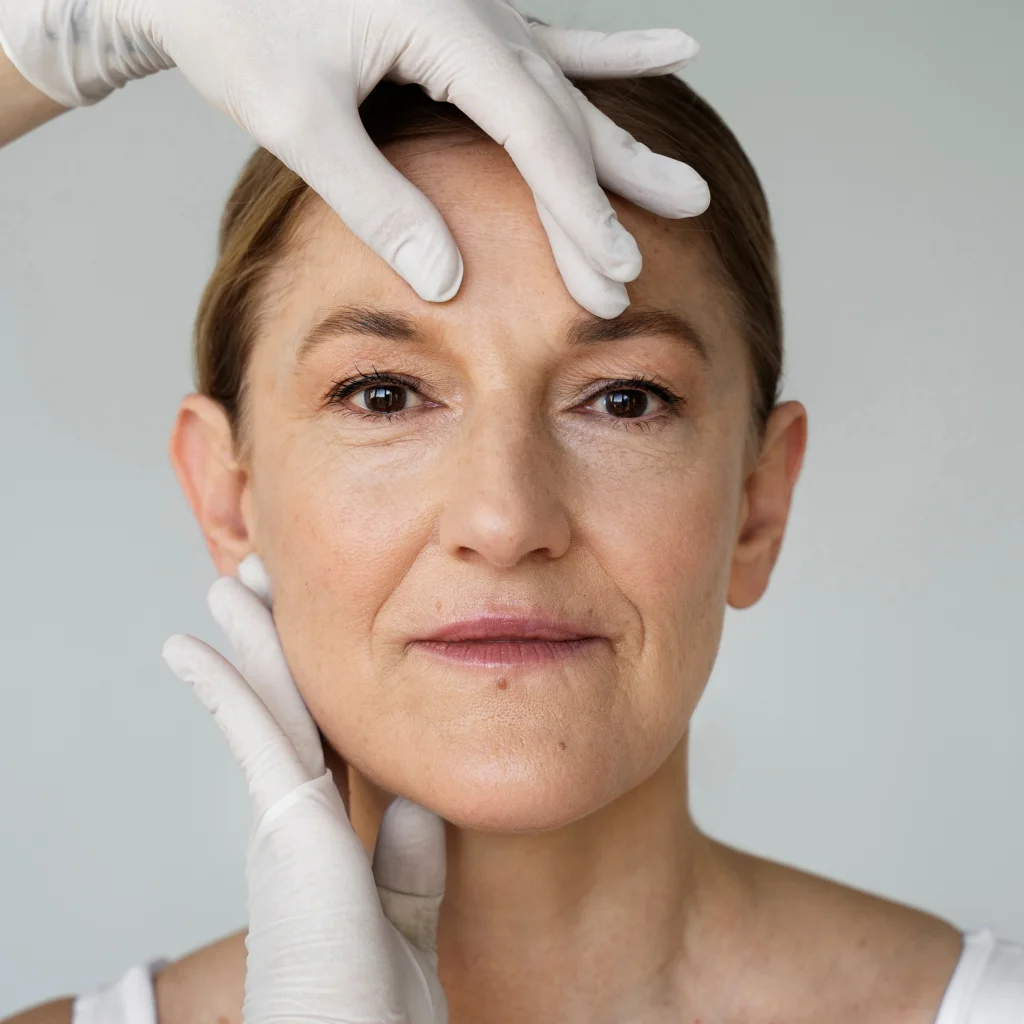
Dermal fillers are injectable treatments used to restore lost facial volume, sculpt and define facial contours, soften lines and folds, and enhance specific features — all without surgery and with minimal downtime. At The Face Institute, fillers are administered exclusively by our facial specialists: surgeons and clinicians with a deep, anatomical understanding of the face who approach every treatment with the same rigour and restraint as a surgical procedure.
We use only hyaluronic acid (HA) based fillers from premium, clinically validated brands — selected for their specific rheological properties relative to the area being treated. HA is a naturally occurring substance in the body, making these fillers biocompatible, reversible, and well-tolerated. Different formulations offer different viscosities and lifting capacities: a firm, cohesive gel is appropriate for structural augmentation of the jawline or cheeks, while a softer, more fluid product is suited to delicate areas such as the lips or tear trough.
Our philosophy is one of precision and restraint. The goal of filler treatment is never to change the face — it is to restore what time has taken, enhance what is already there, and achieve a result that looks entirely like the patient at their best. We actively counsel against over-treatment and are honest about the limitations of fillers versus what surgical intervention can more effectively achieve.
Where We
Treat
Each area of the face has distinct anatomy, tissue characteristics, and aesthetic goals — and demands a different filler formulation, depth, and technique to treat it safely and effectively.
Cheeks & Midface
Restores the lifted, full quality of youthful cheekbones — addressing the volume loss and descent that hollows the midface and creates jowling and nasolabial deepening in the lower face.
Tear Trough & Under-Eye
Softens the hollow shadow at the lid–cheek junction — the tear trough — that creates a persistently tired appearance. Treated with fine, carefully placed product at the correct depth to avoid the Tyndall effect.
Lips
Enhances lip shape, definition, and volume with precision — sharpening the vermilion border, defining the Cupid's bow, and adding subtle fullness without the overfilled or projected appearance that results from over-treatment.
Jawline
Creates definition and structure along the jawline — improving the chin-to-ear contour, reducing soft tissue laxity at the mandibular border, and projecting a sharper, more defined lower face on profile and three-quarter view.
Nasolabial Folds & Marionette Lines
Softens the deep lines running from the nose to the mouth and from the mouth toward the chin — treating both the fold itself and addressing the volume loss in the cheek above that drives their formation.
Temples & Forehead
Restores volume to the hollow temples — one of the earliest and most overlooked signs of facial ageing — creating a smoother transition from brow to hairline and a less skeletal upper face in repose and on profile.
Before & After
Drag the divider on each case to compare before and after results.
Results vary by individual. All cases presented with patient consent and in accordance with local medical advertising guidelines.
Common
Questions
Have a question not answered here? Bring it to your consultation — our specialists take the time to answer everything, thoroughly and honestly.
Are dermal fillers safe?
Hyaluronic acid fillers have an extensive clinical safety record when administered by properly trained practitioners. At The Face Institute, all filler treatments are performed by experienced facial specialists with a thorough understanding of vascular anatomy — the knowledge required to minimise the risk of serious complications such as vascular occlusion. We stock hyaluronidase at all times for emergency reversal and follow strict injection protocols to prioritise patient safety above all else.
How long do dermal fillers last?
Duration depends on the area treated, the product used, the volume injected, and individual metabolism. As a general guide, lip filler typically lasts 6 to 9 months; cheek and midface filler 12 to 18 months; and structural areas such as the jawline or temples may last 12 to 24 months. Results diminish gradually rather than disappearing suddenly — and many patients choose to maintain their result with a light top-up treatment rather than starting from scratch.
Can fillers be dissolved if I am unhappy with the result?
Yes. One of the key advantages of hyaluronic acid fillers is their reversibility. Hyaluronidase — an enzyme that breaks down hyaluronic acid — can be injected to dissolve filler partially or completely, in the event of an unwanted result, an asymmetry, or a complication. This is an important safety feature that distinguishes HA fillers from permanent or semi-permanent injectables, which we do not use.
Is the treatment painful?
Most patients experience mild to moderate discomfort during filler injections, which is well-tolerated. All of our filler products contain lidocaine — a local anaesthetic — within the formulation, which significantly reduces discomfort after the first injection. Topical anaesthetic cream is applied before treatment in sensitive areas such as the lips. Most patients find the experience considerably more comfortable than they anticipated.
What is the downtime after filler treatment?
Swelling, redness, and occasional bruising at injection sites are the most common post-treatment effects — typically resolving within 24 to 72 hours. Lip filler tends to cause more noticeable swelling than other areas, which settles over 3 to 5 days. Most patients resume normal activities immediately after treatment and are comfortable being seen socially within one to two days. We advise avoiding strenuous exercise, alcohol, and excessive heat for 24 hours after treatment.
How do I know if I need fillers or surgery?
This is one of the most important questions in facial aesthetics — and one we take seriously. Fillers are excellent for restoring moderate volume loss, refining features, and softening lines in patients with good tissue quality and early to moderate ageing. When tissue laxity, structural descent, or significant loss of elasticity is the primary concern, surgery provides a correction that filler cannot replicate and that — when attempted with filler — leads to an overfilled, heavy appearance. We will always give you an honest assessment of which approach is appropriate for your anatomy and goals.
Do you offer a consultation before treatment?
Yes — always. We do not perform same-day filler treatments without a prior assessment. Every patient is seen in consultation first, during which we review their medical history, assess their facial anatomy, discuss their goals, and agree on a treatment plan. This ensures that fillers are the appropriate intervention, that the product and technique selected are correct for the area, and that the patient is fully informed before proceeding.
You May Also
Consider


Ready to take
the next step?
Book a consultation with our specialists — we'll assess your face, discuss your goals, and design a precise, considered treatment plan tailored entirely to your anatomy.